
Evaluation of Food Barley (Hordeum vulgare L.) Varieties against Scald, Spot Blotch and Net Blotch Disease in Siltie and Gurage Zone, Central Ethiopia Region
-
Metiku Kebede

Department of Plant Pathology, Central Ethiopia Agricultural Research Institute, Werabe Agricultural Research Center, Werabe, Ethiopia
Yisahak TsegayeDepartment of Plant Pathology, South Ethiopia Agricultural Research Institute, Arbaminch Agricultural Research Center, Arbaminch, Ethiopia
Kedir BamudDepartment of Plant Pathology, Central Ethiopia Agricultural Research Institute, Werabe Agricultural Research Center, Werabe, Ethiopia
| Received 05 Dec, 2025 |
Accepted 01 Mar, 2026 |
Published 31 Mar, 2026 |
Background and Objective: Barley (Hordeum vulgare L.) production in Ethiopia is constrained by foliar diseases, particularly Scald (Rhynchosporium secalis), Spot blotch (Bipolaris sorokiniana, teleomorph Cochliobolus sativus), and Net blotch (Pyrenophora teres). These diseases significantly reduce grain yield and quality. This study aimed to evaluate the resistance of ten food barley varieties to Scald, Spot blotch, and Net blotch under natural infestation in the Siltie and Gurage zones of central Ethiopia. Materials and Methods: A field experiment was conducted using a randomized complete block design with three replications across three locations. Disease severity and Area Under Disease Progress Curve (AUDPC) were recorded for Scald, Spot blotch, and Net blotch. Grain yield was measured at harvest, and correlations between disease severity and yield were analyzed using combined Analysis of Variance (ANOVA) at p≤0.05. Results: A combined analysis of variance over three locations revealed a significant (p≤0.05) difference among examined varieties for scald, spot blotch, and net blotch disease. The verities Abdene and Biftu exhibited the highest scald severity of 25.7%, 24.5%, respectively. The maximum AUDPC for spot blotch was found in the varieties EH-1493 and Guta (656.9% days and 655.1% days, respectively). The lowest AUDPC of net blotch (154.9% days, 170.3% days) were obtained from Robera and HB1307, respectively. The highest grain yield of 5454.2 kg/ha, 5460.9 kg/ha were obtained from Adoshe and Robera, respectively. The terminal severity of scald, net blotch, and spot blotch showed a significant negative correlation with grain yield, with a correlation coefficient ranging from r = -0.25* to r = -0.79**. Conclusion: Adoshe and Robera were best performing and recommended varieties for the areas and with similar agro ecologies. However, further research on multiple diseases resistant variety development is crucial by identifying important sources of resistance genes.
| Copyright © 2026 Kebede et al. This is an open-access article distributed under the Creative Commons Attribution License, which permits unrestricted use, distribution, and reproduction in any medium, provided the original work is properly cited. |
INTRODUCTION
Barley (Hordeum vulgare L.) is a valuable commodity in Ethiopia, with a long history of cultivation and a wide range of agro-ecological and cultural practices1. The crop is known to provide food and related products for millions of people. Barley is Ethiopia's fifth most important cereal crop in terms of land coverage and annual production2. Ethiopia is the leading producer of barley in Africa with the total volume of 2.1-2.5 million metric ton of yield was harvested from one milon hectare of arable land during 20232. In Ethiopia barley crop is well suited in the cool and moist conditions found in the highlands and it an important component of crop rotations and mixed farming systems3. In spite of the huge importance of barley as a crop, various factors like diseases, soil acidity, and week weed management limit the yield potential of the crop4. Foliar diseases are the primary yield-limiting biotic factors in many barley-producing areas around the world. Among these, barley scald, blotch, and other foliar diseases are the major biotic factors both globally and in Ethiopia5,6.
Barley scald caused by Rhynchosporium secalis is one of the most important destructive fungal diseases of barley worldwide, resulting in yield losses of up to 40% and poor grain quality7. The pathogen is polycyclic, involving multiple pathogen generations during the growing season and spreading secondary disease through splash-dispersed conidia8,9. In Ethiopia, barley scald is the most common and extensive disease resulting in massive yield loss10. The yield loss assessment over locations in the central highlands of Ethiopia revealed that average grain yield loss due to scald combined ranged from 14 to 25% in 1999 and 2000, respectively, while yield losses of 9.8 to 31.5% resulted from scald in western Ethiopia11. In other studies, yield losses close to 100% have been reported under severe epidemics on susceptible cultivars12. Net blotch is one of the most important destructive diseases of barley13. This disease is caused by Pyrenophora teres fungus, and forming dark and chocolate-colored blotches on the leaves, eventually forming irregular dead patches, and these reduce the photosynthetic potential of the barley leaf. The yield loss caused by net blotch ranged from 10 to 40%14. Spot blotch is another foliar disease of barley caused by Bipolaris sorokiniana (Sacc. in Sorok.), a serious fungal disease with a large geographical distribution. In Australia, spot blotch has been reported to cause a 44% yield loss15. Disease epidemics in these areas are most likely caused by shifts in pathogen virulence in response to changes in resistance/susceptibility in the most common cultivars grown.
Several studies have shown that host resistance is the most important defense mechanism for controlling barley diseases16,17. Moreover, some studies have shown the resistance of barley materials to scald disease18. Developing barley varieties with durable resistance offers an effective, sustainable, and environmentally friendly strategy for managing scald and blotch diseases. Most Ethiopian barley landraces contain valuable resistance genes against several barley diseases, including scald19,20. However, despite notable progress in disease management strategies, no research has been conducted in the study area to evaluate barley varieties for disease resistance and yield across different locations. Therefore, the present study was undertaken to assess barley varieties for their resistance to scald, spot blotch, and net blotch diseases in the central region of Ethiopia.
MATERIALS AND METHODS
Description of experimental areas: Werabe agricultural research center (WARC) conducted the experiments at its research sites in Albazar, Alicho, and Geta during the 2022 growing season under rainfed conditions. The experimental sites are located in major barley growing areas of central Ethiopia, characterized by Dega and Woinadega agro ecologies. Mixed agriculture is the most common economic activity among farmers in the areas. Albazer main station is located at 07°84'65''N, 38°18'18''E and 2309 m.a.s.l. The annual rainfall in the area ranges from 650 to 950 mm, indicating a midland agro ecology. The average annual minimum and maximum temperatures are 11.05 and 18.79°C, respectively. The soil type is dominated by clay soil (Cromic Luvisole and Haplic phaeozems), which has a slightly acidic. Alicho research site is located at 07°56'96''N, 38°09'39''E and 2870 m.a.s.l. The annual rainfall ranges between 750 and 1190 mm, indicating highland agro ecology. The average annual minimum and
maximum temperatures are 8.1°C and 16.7°C, respectively. The most common soil type is clay (pellic vertisole). The Geta research site is situated 07°47'52''N, 37°43'36''E and 2974 m.a.s.l. It has a mean annual rainfall of 910 mm and an average annual temperature of 13.8°C, indicating highland and high rainfall agro ecology. The soil type is dominated by sandy loam soil (Cromic Luvisol). All locations represent scald, spot, and net blotch-prone areas of the central Ethiopia region and are characterized by bimodal rainfall, the short rainy season extending from March to May and the main rainy season from June to September.
Experimental design and treatments: Appropriate design of Randomized Complete Block Design (RCBD) with three replications was used for the experiment. Ten released food barley varieties were collected from Regional and National agricultural research center and field evaluated for scald, spot blotch and net blotch diseases. The tested food varieties were sown in experimental plots measuring 1.2 m×2.5 m or (3 m2) each containing 6 rows; spaced 0.2 m apart. The distance between plots and blocks was 0.5 and 1 m, respectively. The seed rate of each variety was sown at 100kg ha-1 on well prepared seed bed and manually sown in rows on June 21 at Albazar, June 30 at Alicho and July 10 at Geta during the 2022 cropping season. During planting 100kg/ha-1 NPS and 150 kg/ha-1 urea fertilizers were applied manually and three times hand weeding were carried out during the growing season to make the plots weed-free in all locations.
Diseases assessment: Disease severity was assessed by estimating the percentage of infected leaf tissue at seven-day intervals on ten randomly selected pre-tagged plants with harvestable rows per plot from the time of symptom appearance to crop physiological maturity21. The mean disease severity per plant represented the average severity of ten plants evaluated per plot. The resistance level of scald and net blotch was assessed from 00-99 scoring scale22. The analysis was based on the mean scald, spot, and net blotch severity obtained from 10 plants in each plot. The integral model, i.e., Area Under Disease Progress Curve (AUDPC), the development of disease on a whole plant or parts of the plant, was assessed for each disease at different DAP for each plot, applying the following formula23:
Where,
| Xi | = | Percentage of disease severity index (PSI) of disease at ith assessment | |
| ti | = | Time of the ith assessment in days from the first assessment date | |
| n | = | Total number of disease assessments |
Yield parameter assessment: All agronomic data were recorded from four central rows on each experimental unit. Details of the agronomic parameters measured are the following:
| • | Spike length (SL) (cm): The average length of spikes from 10 randomly taken plants on four central rows of each plot was measured | |
| • | Kernels per spike (KPS): The number of kernels of main tillers on each of 10 randomly selected plants was counted, and the average of 10 plants was used for data analysis | |
| • | Thousand kernels weight (TKW) (g): The weight of one thousand kernels was counted by carefully using a seed counter, adjusting to 12.5% moisture content, and weighing them using a sensitive balance | |
| • | Grain yield (GY): Grain yield was adjusted to a moisture content of 12.5% and measured from the four central rows in each plot and converted into kg/ha-1 |
Statistical analysis: Data from each of the three locations were analyzed using ANOVA, and combined analyses across locations were performed using the General Linear Model Procedure of the SAS software package version 9.3. The treatment means were compared using the least significant difference (LSD) test at the 5% probability level. The Pearson correlation procedures were used to determine the relationship between disease parameters, yield, and yield components.
RESULT
Disease severity: The study found significant (p<0.05) differences between tested food barley for scald, spot blotch, and net blotch diseases (Table 1). The maximum terminal severity of spot blotch was 28.3% for EH-1493 and 28.9% for Guta (Table 1). While the lowest terminal severities of 9.1% and 9.7% were recorded from Robera and HB 1307 respectively, by Net blotch diseases (Table 1). Variation in resistance to scald, spot, and net blotch disease of varieties was due to genetic differences. The variety HB1307 is more susceptible to spot blotch than other varieties tested. Compared to scald and net blotch disease, the spot blotch severity symptom is high, showing faster epidemic development, which could be due to its polycyclic nature of disease.
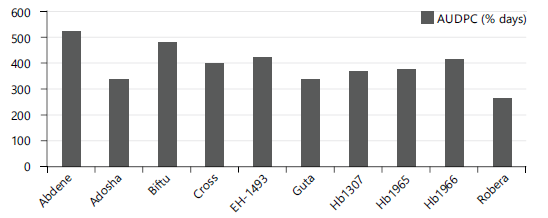
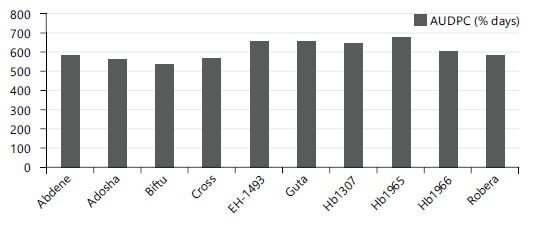
Area under diseases progress curve: The Area under diseases progress curve (AUDPC) was significantly different (p<0.05) among the food barley varieties to scald, spot and net blotch disease. The highest of AUDPC values for spot blotch (656.9% days, 655.1% days, and 677.8% days) were recorded from EH-1493, Guta and HB 1965, respectively. The lowest AUDPC of 154.9% days on Robera, 197.6% days on Biftu and 170.3% days on HB 1307 were recorded from net blotch disease. On the other hand the highest AUDPC of value of scald (518.4% days and 480.6% days) were recorded from Abdene and Biftu, respectively Fig. 1 and 2.
Spike length: Analysis of variance revealed a significant (p<0.05) difference in spike length across food barely varieties. Spike length is one of the most important parameters influencing grain yield. The highest spike length of 7.3 cm was obtained on HB 1966, followed by EH-1493 (7.2 cm). The least spike length (6.3 cm) was obtained from Guta.
Kernel per spike: There was a significant (p<0.05) difference in the number of kernels per spike (KPS) across locations (Table 1). Variety EH1493 and HB 1307 produced the most kernels per spike (60.9 and 57.9, respectively), while Guta and Cross produced the lowest (50.2 and 52.2). Barley foliar diseases reduced the number of kernels per spick, contributing to the lowest grain yield.
Thousand kernel weight: The performance of food barley varieties in terms of thousand kernel weight (TKW) revealed a significant (p<0.05) difference over locations. Robera and HB 1965 produced the highest TKW values of 49.3 g and 49.2 g, respectively (Table 1). Whereas, the minimum TKW of 42.7, 41.6, 42.6, and 42.7 g were obtained from the varieties Abdene, Biftu, EH-1493 and Robera, respectively (Table 1). The diseases hurt the kernel quality and quantity of produce during the experiment.
|
|
| Table 1: | Combined analysis result of barley varieties for diseases and yield components at Albazar, Alicho, and Geta woredas in 2022 cropping season | |||
| (%) | Day (%) | |||||||||
| Variety | (T)scald | (T)spot | (T)net | (AUDPC)scald | (AUDPC)spot | (AUDPC)net | SL | KPS | TKW (gm) | GY (kg) |
| Abdene | 25.7a | 23.3cd | 12.8ab | 518.6a | 580.1cd | 263.4a | 6.7cd | 56.6a-c | 42.7c | 4770.7bc |
| Adoshe | 18.8c | 22.8d | 12.4a-c | 363.4cd | 564.9d | 249.5a | 6.7cd | 56.5a-c | 47.9ab | 5460.9a |
| Biftu | 24.5a | 22.2d | 10.6bd | 480.4a | 537.3d | 197.3c | 7.1ac | 57.2a-c | 41.6c | 4470.9c |
| Cross | 19.2c | 23.3cd | 12.9a | 400.2bc | 571.3d | 210.2bc | 6.5de | 52.2cd | 48.6a | 5046.2a-c |
| EH-1493 | 22.8ab | 28.3ab | 10.2c-d | 423.3b | 656.9ab | 210.9bc | 7.2ab | 60.9a | 42.6c | 4702.4bc |
| Guta | 17.3c | 28.9a | 10.3c-d | 346.4d | 655.1ab | 207.5bc | 6.2e | 50.2d | 47.8ab | 5166.9ab |
| HB1307 | 16.7cd | 26.7ac | 9.7d | 367.4c-d | 644.9a-c | 170.3d | 6.7cd | 57.9ab | 46.0b | 5235.5ab |
| HB1965 | 18.8c | 27.8ab | 11.1ad | 377.1bd | 677.8a | 205.7bc | 6.8b-d | 56.7abc | 49.2a | 5231.1ab |
| HB1966 | 20.0bc | 25bd | 13.2a | 410.6bc | 604.6bd | 225.6b | 7.3a | 55.7bc | 42.7c | 4727.7bc |
| Robera | 13.3d | 23.9cd | 9.1d | 267.9e | 580.9cd | 154.9d | 6.3de | 54.5b-d | 49.3a | 5454.2a |
| Mean | 19.7 | 25.2 | 11.2 | 395.5 | 609.2 | 209.1 | 6.7 | 55.8 | 45.8 | 5006.6 |
| CV% | 19.3 | 15.7 | 21.6 | 23.7 | 16.9 | 11.6 | 7.6 | 8.6 | 5.06 | 12.8 |
| LSD0.05 | 19.7 | 25.2 | 11.2 | 395.5 | 609.2 | 209.1 | 6.74 | 55.8 | 45.8 | 5006.6 |
| LSD0.05: List significant difference at 5%, CV (%): Coefficient of variation at (%), Means in same column followed by the same letters are not significantly different, (T)scald: Scald terminal severity, (T)spot: Spot blotch terminal severity, AUDPCscald: Scald area under disease progress curve, AUDPCspot: Spot blotch area under disease progress curve, AUDPCnet: Net blotch area under disease progress curve, SL: Spike length, KPS: Kernel per spike, TKW: Thousand kernel Weight and GY: Grain Yield | ||||||||||
| Table 2: | Correlation procedures between diseases and yield component | |||
| (T)scald | (T)spot | (T)net | (AUDPC)scald | (AUDPC)spot | (AUDPC)net | SL | KPS | TKW | GY | |
| (T)scald | ||||||||||
| (T)spot | 0.76** | |||||||||
| (T)net | 0.61** | 0.55** | ||||||||
| (AUDPC)scald | 0.84** | 0.91** | 0.38* | |||||||
| (AUDPC)spot | 0.62** | 0.82** | 0.70** | 0.53** | ||||||
| (AUDPC)net | 0.55** | 0.35** | 0.27* | 0.31* | 0.40* | |||||
| SL | -0.17ns | 0.09ns | -0.41* | -0.23* | -0.11* | -0.05ns | ||||
| KPS | -0.26* | -0.23* | -0.22* | -0.29* | -0.36* | -0.31* | 0.77** | |||
| TKW | -0.41* | -0.76 | -0.23* | -0.54** | -0.60** | 0.19ns | 0.41* | 0.45** | ||
| GY | -0.79** | -0.59** | -0.25* | -0.71** | -0.48** | -0.63** | 0.27* | 0.41* | 0.28* | |
| **Refers to mean values Significant = 0.01, *Refers mean square values Significant = 0.05, ns: Refers mean square values not significant = 0.05, (T)scald: Scald terminal severity, (T)spot: Spot blotch terminal severity, AUDPCscald: Scald area under disease progress curve, AUDPCspot: Spot blotch area under disease progress curve, AUDPCnet: Net blotch area under disease progress curve, SL: Spike length, KPS: Kernel per spike, TKW: Thousand kernel Weight and GY: Grain Yield | ||||||||||
Grain yield: Significant variation was noticed (p<0.05) for the grain yield among the food barley varieties (Table 1 ). The lowest grain yield in kg/ha was harvested from the plot cultivars of Biftu (4470.2 kg/ha), EH-1493 (4702.3 kg/ha), HB1966 (4727.2 kg/ha), and Abdene (4770.7 kg/ha), which were significantly different from the varieties of Adoshe (5460.9 kg/ha) and Robera (5454.2 kg/ha) (Table 1). The varieties cross (5046.2 kg/ha), Guta (5166.9 kg/ha), HB 1307 (5235.5 kg/ha), and HB 1965 (5231.1 kg/ha) had more or less similar grain yield in kg/ha during the test of variety reaction to scald, spot, and net blotch disease assessments (Table 1).
Correlation analysis between disease and agronomic variables: Correlation analysis of the data revealed a negative correlation between terminal severity and Area under disease progress curve with grain yield and thousand kernel weights in all recorded diseases (Table 2). The grain yield and terminal scald severity had a negative and strong correlation (r = -0.79**) (Table 2). This implies that as disease severity increased, yield parameters decreased, and vice versa. This could be attributed to favorable environmental conditions for the development of scald disease during the growing season.
DISCUSSION
The spot blotch affected the barley foliage, reducing photosynthetic capacity and resulting in yield losses. In contrast, the variety Biftu showed relatively higher resistance to spot blotch when compared to the other varieties tested. Similarly24, barley genotypes that are resistant to spot blotch. Less susceptibility of the varieties to net blotch, which may be due to disease escape, which may be one of the reasons why plants appear to be more resistant, is primarily based on unfavorable growing conditions for fungi such as drought and temperature, as well as plant height, maturity, and canopy structure, which limit pathogen spread9. According to a study25, plant resistance loss and pathotype resistance development in a given pathogen were caused by the breakdown of the plant's resistance gene and the development of a new race or genetic modification by the pathogen as a result of risky disease management options. Furthermore, the variability of pathogens, particularly Rhynchosporium secalis, causes the breakdown of a single resistance gene in the field, making breeding for scald resistance difficult9. In the presence of phenotypic diversity, identifying important sources of effective resistance genes against scald and blotch disease is critical to increasing genetic diversity, improving durability, and reducing the risk of yield loss.
The yield loss of food barley varieties was dependent on the AUDPC. This is because AUDPC is an accurate measure of disease parameters. A AUDPC also estimated the resistance level of various food barley varieties. This is because: AUDPC represents both the amount of infection and the rate at which the disease or pathogen has increased during an epidemic. AUDPC value of scald and spot blotch was varied depending on the resistance level of the variety and the prevailing environmental conditions. The variety Adoshe showed relatively, the lowest AUDPC value to triple diseases and produces the higher grain yield. However, no varieties showed immune reaction throughout of the assessment period for to any of diseases. This could be due to the breakdown of a major or minor gene, which does not provide the best protection against existing diseases.
Scald and spot blotch reduced spike length and the number of kernels per spike and resulting in the lowest grain yield. However, even under the most severe disease conditions, the majority of the evaluated cultivars outperformed in terms of both parameters. Moreover, considerable amount of variations was prevalent across locations among varieties to spike length and kernel per spike. However, the variations in spike length and number of spike among food barely varieties were primarily based on the genetic background of the cultivar rather than disease pressure. Therefore, the breeding program should focus on the most desirable yield-contributing traits, such as spike length and the number of kernels per spike, to enhance the productivity barley. These should be addressed by developing high yielding and disease resistant varieties that also have a broad range of adaptation under variable agro climatic conditions. This is because the use of resistant barley varieties is the most effective, economical, and environmentally friendly method of controlling fungal diseases in barley, as integrated cereal disease protection is primarily based on the cultivar and its genetically established resistance16.
The performance of food barley varieties varies in terms of grain yield across locations. This could be due to variability of the pathogen or differences in the environment between test locations. These findings are consistent with previous research in which cultivar performance was influenced by the environment in which they grew26 have all reported variation in pathotypes and/or environmental differences between locations, resulting in variations in disease levels. The combination of many diseases in single plant decrease the photosynthetic capacity, resulting in a decrease in carbohydrate levels in the kernel15,27,28 Farmers in the study areas use old and susceptible food varieties. Therefore, adoption of recently released food barely varieties is important to combat the scald, spot, and net blotch diseases.
CONCLUSION
A combined analysis of variance revealed significant variation among barley varieties in terms of disease and other agronomic traits. In the presence of the genetic potential of the barley varieties tested, their performance was highly influenced by scald, spot blotch, and net blotch disease across locations. According to specific area information, Biftu and Abdene are susceptible to scald, while Guta and HB1965 are more susceptible to spot blotch diseases. As a result, Adoshe and Robera are the most widely recommended varieties across areas due to their higher grain yield advantage. Large-scale production of Adoshe and Robera is necessary to replace old varieties with new ones and meet farmers’ seed requirements. There has been little breeding progress in Ethiopia to achieve adequate levels of resistance to barley foliar diseases. Therefore, further screening and evaluation of barley genotypes for multiple disease resistance is required in multiple locations to confirm responses in different environments, as the environment has been shown to play a significant role in the reaction to scald, spot, and blotch diseases.
SIGNIFICANCE STATEMENT
This study provides practical evidence on the performance of ten food barley varieties against major foliar diseases in central Ethiopia. The findings identify Adoshe and Robera as relatively disease-tolerant and high-yielding varieties, supporting informed varietal selection in Siltie and Gurage Zones. The documented negative correlation between disease severity and yield highlights the importance of integrated disease management and resistance breeding strategies.
ACKNOWLEDGMENT
The author would like to thank Southern Agricultural Research Institute for providing financial support and Werabe Agricultural Research Center for providing the necessary research facilities, particularly the crop protection team for their efforts in trial management and data collection.
REFERENCES
- Eticha, F., W. Sinebo and H. Grausgruber, 2010. On-farm diversity and characterization of barley (Hordeum vulgare L.) landraces in the highlands of West Shewa, Ethiopia. Ethnobotany Res. Appl., 8: 25-34.
- Ahmed, M., S. Ahmad, G. Abbas, S. Hussain and G. Hoogenboom, 2024. Cropping Systems Modeling Under Changing Climate. 1st Edn., Springer Nature, Singapore, ISBN: 978-981-97-0331-9, Pages: 430.
- Snapp, S.S., C.M. Cox and B.G. Peter, 2019. Multipurpose legumes for smallholders in Sub-Saharan Africa: Identification of promising ‘scale out’ options. Global Food Secur., 23: 22-32.
- Teklemariam, S.S., K.N. Bayissa, A. Matros, K. Pillen, F. Ordon and G. Wehner, 2022. The genetic diversity of Ethiopian barley genotypes in relation to their geographical origin. PLoS ONE, 17.
- Mohammed, T.A., B.B. Yeshnigus and A.H. Welderufael, 2021. Distribution and importance of Barley (Hordeum vulgare) fungal diseases in Ethiopia. Am. J. Biosci., 9: 128-133.
- Xi, K., C. Bos, T.K. Turkington, A.G. Xue, P.A. Burnett and P.E. Juskiw, 2008. Interaction of net blotch and scald on barley. Can. J. Plant. Pathol., 30: 329-334.
- Zhan, J., L. Yang, W. Zhu, L. Shang and A.C. Newton, 2012. Pathogen populations evolve to greater race complexity in agricultural systems- evidence from analysis of Rhynchosporium secalis virulence data. PLoS ONE, 7.
- Zaffarano, P.L., B.A. McDonald, M. Zala and C.C. Linde, 2006. Global hierarchical gene diversity analysis suggests the fertile crescent is not the center of origin of the barley scald pathogen Rhynchosporium secalis. Phytopathology, 96: 941-950.
- Zhan, J., B.D.L. Fitt, H.O. Pinnschmidt, S.J.P. Oxley and A.C. Newton, 2008. Resistance, epidemiology and sustainable management of Rhynchosporium secalis populations on barley. Plant Pathol., 57: 1-14.
- Crous, P.W., U. Braun, B.A. McDonald, C.L. Lennox and J. Edwards et al., 2021. Redefining genera of cereal pathogens: Oculimacula, Rhynchosporium and Spermospora. Fungal Syst. E, 7: 67-98.
- Shehabu, M. and A. Tekalign, 2004. Yield loss due to scald and net blotch on barley in North Shewa. Pest Manage. J. Ethiop., 8: 111-118.
- Yirgu, M., M. Kebede, T. Feyissa, B. Lakew, A.B. Woldeyohannes and M. Fikere, 2023. Single nucleotide polymorphism (SNP) markers for genetic diversity and population structure study in Ethiopian barley (Hordeum vulgare L.) germplasm. BMC Genomic Data, 24.
- Beyene, N. and A. Abera, 2020. Evaluation of different fungicides for the control of net blotch (Pyrenophora teres) disease on barley (Hordeum vulgare L.) at West Showa Zone, Ethiopia. J. Plant Pathol. Microbiol., 11.
- Mathre, D.E., 1997. Compendium of Barley Diseases. APS Press, St. Paul, Minnesota, USA, ISBN: 9780890541807, Pages: 90.
- Jayasena, K.W., A. van Burgel, K. Tanaka, J. Majewski and R. Loughman, 2007. Yield reduction in barley in relation to spot-type net blotch. Australas. Plant Pathol., 36: 429-433.
- McDonald, B.A. and C. Linde, 2002. Pathogen population genetics evolutionary potential and durable resistance. Annu. Rev. Phytopathol., 40: 349-379.
- Zeleke, T., 2017. Evaluation of host reaction and yield performance of malt barley cultivars to net blotch, Pyrenophora teres in Bale Highlands, Ethiopia. J. Plant Sci., 5: 43-47.
- Daba, S.D., R. Horsley, R. Brueggeman, S. Chao and M. Mohammadi, 2019. Genome-wide association studies and candidate gene identification for leaf scald and net blotch in barley (Hordeum vulgare L.). Plant Dis., 103: 880-889.
- Zewodu, A., W. Mohammed and E. Shiferaw, 2024. Analysis of genetic diversity and population structure of some Ethiopian barley (Hordeum vulgare L.) accessions using SSR markers. PLoS ONE, 19.
- Bekele, B., A. Abraham, S.G. Kumari, S. Ahmed, C. Fininsa and A. Yusuf, 2019. Ethiopian barley landraces: Useful resistant sources to manage Barley yellow dwarf and other foliar diseases constraining productivity. Eur. J. Plant Pathol., 154: 873-886.
- Arabi, M.I.E., M. Jawhar, B. Al-Safadi and N. Mirali, 2004. Yield responses of barley to leaf stripe (Pyrenophora graminea) under experimental conditions in Southern Syria. J. Phytopathol., 152: 519-523.
- Singh, S., H. Singh, A. Sharma, M. Meeta and B. Singh et al., 2014. Inheritance of spot blotch resistance in barley (Hordeum vulgare L.). Can. J. Plant. Sci., 94: 1203-1209.
- Wilcoxson, R.D., B. Skovmand and A.H. Atif, 1975. Evaluation of wheat cultivars for ability to retard development of stem rust. J. Ann. Appl. Biol., 80: 275-281.
- Verma, R.P.S., D.P. Singh, R. Selvakumar, R. Chand, V.K. Singh and A.K. Singh, 2013. Resistance to spot blotch in barley germplasm. Indian J. Plant Genet. Resour., 26: 220-225.
- Graner, A. and A. Tekauz, 1996. RFLP mapping in barely of a dominant gene conferring resistance to scald (Rhynchosporium secalis). Theor. Appl. Genet., 93: 421-425.
- Shahidur, R., G.T. Abate, S. Lemma, J. Warner, L. Kasa and N. Minot, 2015. The Barley Value Chain in Ethiopia. International Food Policy Research Institute (IFPRI), Washington, D.C., Pages: 61.
- Horsley, R.D. and M. Hochhalter, 2016. Barley: Agronomy. In: Encyclopedia of Food Grains, Wrigley, C., H. Corke, K. Seetharaman and J. Faubion (Eds.), Elsevier, Amsterdam, Netherlands, ISBN: 978-0-12-394786-4, pp: 186-193.
- Jebbouj, R. and B. El Yousfi, 2010. An integrated multivariate approach to net blotch of barley: Virulence quantification, pathotyping and a breeding strategy for disease resistance. Eur. J. Plant Pathol., 127: 521-544.
How to Cite this paper?
APA-7 Style
Kebede,
M., Tsegaye,
Y., Bamud,
K. (2026). Evaluation of Food Barley (Hordeum vulgare L.) Varieties against Scald, Spot Blotch and Net Blotch Disease in Siltie and Gurage Zone, Central Ethiopia Region. Trends in Agricultural Sciences, 5(1), 1-8. https://doi.org/10.21124/tas.2026.01.08
ACS Style
Kebede,
M.; Tsegaye,
Y.; Bamud,
K. Evaluation of Food Barley (Hordeum vulgare L.) Varieties against Scald, Spot Blotch and Net Blotch Disease in Siltie and Gurage Zone, Central Ethiopia Region. Trends Agric. Sci 2026, 5, 1-8. https://doi.org/10.21124/tas.2026.01.08
AMA Style
Kebede
M, Tsegaye
Y, Bamud
K. Evaluation of Food Barley (Hordeum vulgare L.) Varieties against Scald, Spot Blotch and Net Blotch Disease in Siltie and Gurage Zone, Central Ethiopia Region. Trends in Agricultural Sciences. 2026; 5(1): 1-8. https://doi.org/10.21124/tas.2026.01.08
Chicago/Turabian Style
Kebede, Metiku, Yisahak Tsegaye, and Kedir Bamud.
2026. "Evaluation of Food Barley (Hordeum vulgare L.) Varieties against Scald, Spot Blotch and Net Blotch Disease in Siltie and Gurage Zone, Central Ethiopia Region" Trends in Agricultural Sciences 5, no. 1: 1-8. https://doi.org/10.21124/tas.2026.01.08

This work is licensed under a Creative Commons Attribution 4.0 International License.